The player uses two hands to play the đàn tranh, the right hand plucking the strings to make the sound. The left hand makes the ornaments to “nourish” and beautify that sound, turning it into music. As Prof. Dr. Trần Văn Khê once said: “The right hand creates the sound, the left hand nourishes and makes it beautiful”. Indeed, the performing techniques of the left hand are extremely important in the music of the đàn tranh. They not only add a softer sound and gentle beauty to the melody, in accordance with Vietnamese aesthetics, but also express the character of the melody, its regional quality, and the artistic style of the three regions: Chèo, Huế and Tài tử music.
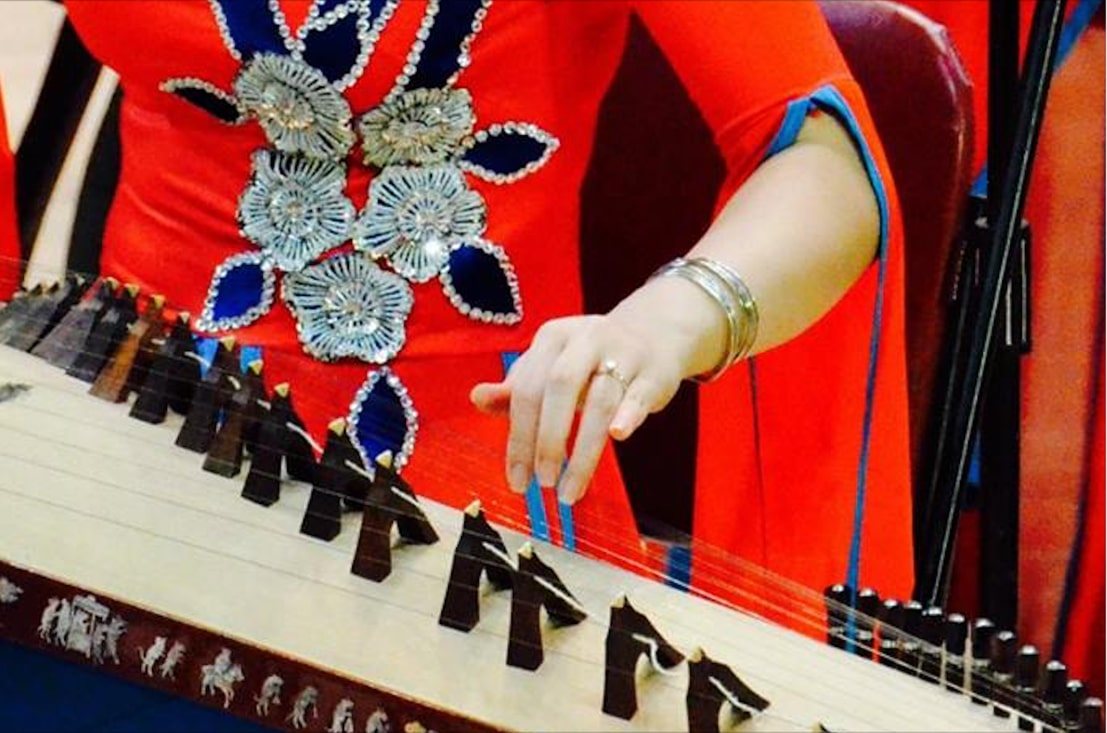
As for the posture of the left hand, the tips of the three middle fingers rest lightly on the strings, moving between the movable bridges and the pegs. The hand is open naturally, while two or three fingers (index, middle and ring finger) gather together. The thumb and little finger are held apart from those three fingers. When vibrating or pressing, the player lifts the hand gently. The three gathered fingers move together from one string to another, or each finger can move separately to make denser ornaments.
Below are the main ornamentation techniques of the đàn tranh, with their notation, a description and a filmed example, followed by the most common combined ornaments.
1. Rung (vibrato)
Rung vibrato is carried out in numerous ways. Players vibrate the string on the left side of the bridge with one, two or three fingers while plucking with the right hand. For a single note the vibrato can be long or short, at a uniform speed, slow or rapid, or varied in speed throughout the note’s decay. It is an essential technique of the đàn tranh, adding a subtle, vocal quality, and is used in all styles.
There are two main types: rung chậm (slow vibrato) and rung nhanh (fast vibrato).
a. Rung nhanh (fast vibrato)

Rung nhanh may be light or heavy depending on the style of music and the rhythm of the piece. It is used in all styles: northern music has a light fast vibrato, southern music a heavier one.
b. Rung chậm (nhún, rung day), slow vibrato
Slow vibrato brings a melancholic touch to the melody. It is the typical fingering of Huế music, in Central Vietnam.
2. Nhấn (inflection)

Ngón nhấn is a glissando ornament in which the original pitch is raised by anything from a semitone to a fifth, depending on the piece. Players use the tips of three left-hand fingers to press, listening to adjust the pressure. The technique also produces intermediate pitches such as a half, a third or a quarter of a tone: press lightly for a semitone, harder for a whole tone.
3. Nhấn luyến xuống, nhả (downward glide)
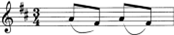
The player releases the pressure on the string with the left hand to produce a legato across different intervals. The sound is soft and flexible, like the inflection of a voice. There are two kinds of downward glide.
Ngón miết
A downward glide released more slowly and over a single step. The right hand plucks first, then the left hand strokes the string towards the peg, or the other way, until the required pitch, making the sound softer and smoother. It can express many shades of feeling: sadness, suffering, resentment, anger, reproach. Ngón miết appears most often in northern Chèo music.
4. Ngón vỗ (tap, mordent)
Two or three fingertips (index, middle and ring finger) slap the string just plucked on the bridge side, then lift immediately, so the sound jumps a semitone or a tone higher. There are two kinds of mordent.
a. Vỗ đồng thời (simultaneous mordent)
The left hand taps at the same moment the right hand plucks. The subordinate note is a semitone or a tone above the main note.
b. Vỗ sau (afterward mordent)
The right hand plucks, then the left hand slaps the string. Part of the sound comes from the pluck, part from the mordent about a semitone or a tone higher; the left hand then lifts at once and the string returns to rest, its remaining resonance depending on the string’s tension. Single, double and multiple taps are all used.
5. Kĩ thuật kết hợp (combined techniques)
These notes combine several ornaments in a single gesture after the sound has been made. This is a distinctive feature of the Vietnamese zither, setting it apart from the other instruments of its family: the guzheng, the koto and the gayageum.
a. Nảy (returning portamento)
The left hand bends the string down, up and down again, so the portamento moves from higher to lower pitch or the reverse. It is used in all styles, especially southern music.
b. Nhấn rung (pressed vibrato)
A combination of nhấn and rung: the left hand first presses the string up to a pitch, then applies vibrato to the raised tone.
c. Nhấn vỗ (pressed tap)
A combination of nhấn and vỗ: the player presses the string to the required pitch, then taps the raised tone.
d. Kỹ thuật mượn nốt (borrowed notes)
When two identical notes follow each other, the player rarely plucks the same open string twice. Instead, one note comes from the open string and the other from a neighbouring string pressed up to the same pitch, a “borrowed note” (nốt mượn). The result is softer and more supple than repeating the open string.